How to Read an IGI Certificate Before Buying a Diamond
Introduction
Buying a diamond is an important decision, whether it's for an engagement ring, a special gift, or a personal investment. Before purchasing any diamond, one document you should never ignore is the IGI Certificate.
An IGI (International Gemological Institute) Certificate is an independent grading report that verifies the quality and authenticity of a diamond. Understanding this certificate can help you make a confident and informed purchase.
What Is an IGI Certificate?
An IGI Certificate is a detailed report prepared by expert gemologists after carefully examining a diamond. It contains all the important information about the diamond, including its:
- Carat Weight
- Color Grade
- Clarity Grade
- Cut Grade
- Measurements
- Polish and Symmetry
- Fluorescence
- Diamond Identification Number
For lab-grown diamonds, the certificate also confirms that the diamond is laboratory-grown and not mined from the earth.
Why Is an IGI Certificate Important?
1. Confirms Authenticity
The certificate ensures that the diamond you are purchasing has been professionally evaluated.
2. Provides Transparency
You know exactly what you are paying for because every important detail is mentioned in the report.
3. Helps Compare Diamonds
Two diamonds may look similar, but their quality and value can be very different. An IGI certificate makes comparison easier.
4. Builds Trust
Certified diamonds give buyers greater confidence and peace of mind.
How to Read an IGI Certificate
1. Report Number
Every IGI certificate has a unique report number.
This number can usually be found:
- On the certificate itself
- Laser-inscribed on the diamond's girdle
You can also verify this number directly on the IGI website.
2. Shape and Cutting Style
This section tells you the shape of the diamond, such as:
- Round Brilliant
- Oval
- Princess
- Cushion
- Emerald
- Pear
The shape affects the diamond's appearance and sparkle.
3. Measurements
Measurements indicate the exact dimensions of the diamond.
For example:
6.50 x 6.45 x 4.00 mm
These measurements help determine whether the diamond has been proportioned correctly.
4. Carat Weight
Carat refers to the weight of the diamond.
Example:
1.00 Carat
A higher carat generally means a larger diamond, but size should always be considered together with the other quality factors.
5. Color Grade
Diamond color is graded from:
D (Colorless) → Z (Light Yellow or Brown)
For lab-grown diamonds, popular choices are usually:
- D
- E
- F
- G
The less color a diamond has, the rarer and more valuable it generally becomes.
6. Clarity Grade
Clarity measures the presence of internal or external characteristics.
Common clarity grades include:
- FL – Flawless
- IF – Internally Flawless
- VVS1 – Very Very Slightly Included
- VVS2
- VS1
- VS2
- SI1
- SI2
Higher clarity grades indicate fewer inclusions.
7. Cut Grade
The cut grade determines how well the diamond reflects light.
Grades generally include:
- Excellent
- Very Good
- Good
- Fair
A well-cut diamond produces exceptional brilliance and sparkle.
8. Polish and Symmetry
Polish
Measures how smooth the diamond's surfaces are.
Symmetry
Measures how precisely the facets align with one another.
Excellent polish and symmetry contribute to better beauty and light performance.
9. Fluorescence
Fluorescence refers to how a diamond reacts under ultraviolet light.
Grades include:
- None
- Faint
- Medium
- Strong
Most buyers prefer diamonds with None or Faint fluorescence.
10. Proportions Diagram
The certificate also contains a visual diagram showing:
- Table %
- Depth %
- Crown Angle
- Pavilion Angle
These proportions influence the diamond's sparkle and overall appearance.
How to Verify an IGI Certificate
Before purchasing a diamond:
✅ Check the certificate number.
✅ Match the certificate details with the actual diamond.
✅ Verify the report on the official IGI website.
✅ Ensure the certificate mentions that the diamond is Lab-Grown if purchasing a lab-grown diamond.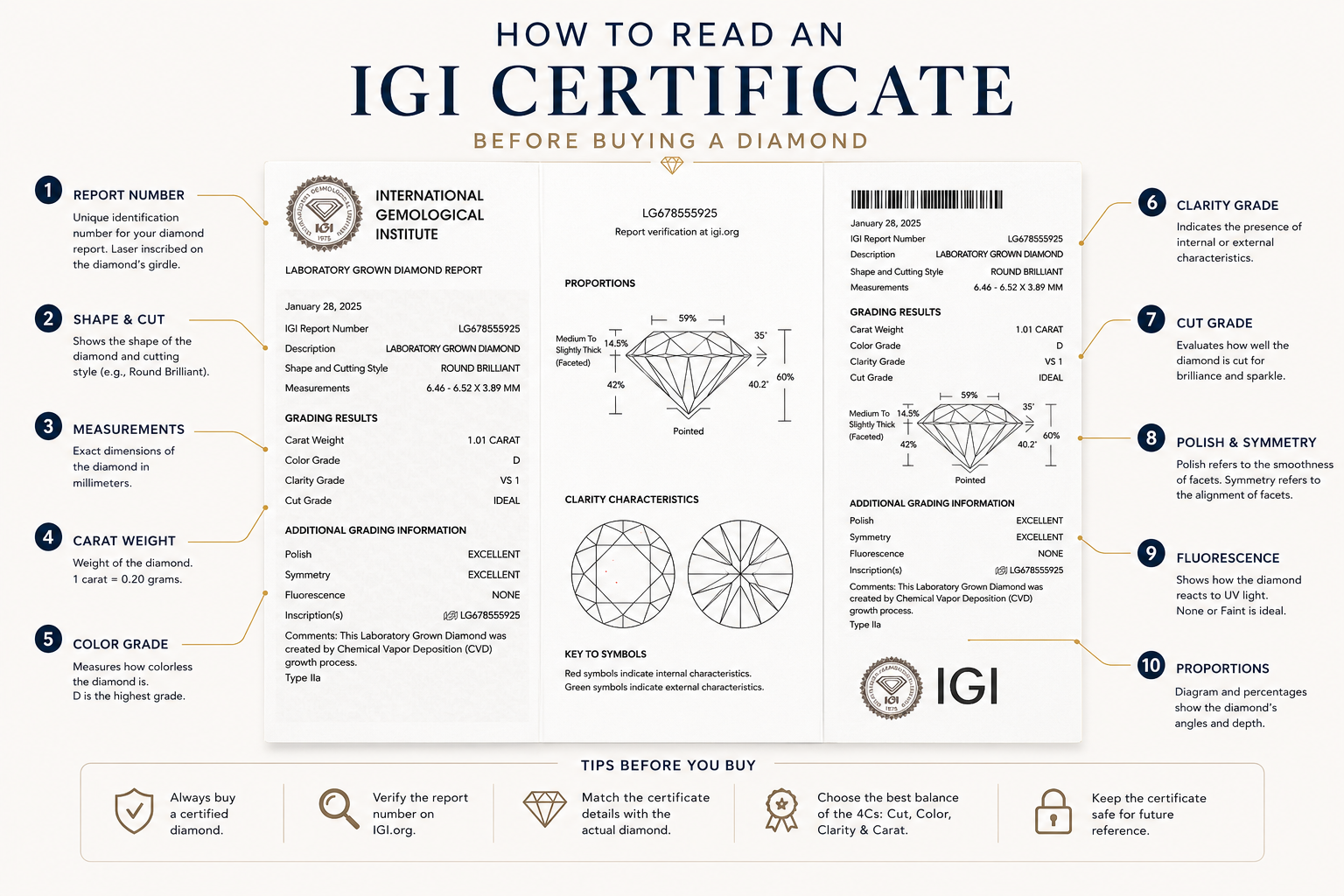
Common Mistakes to Avoid
❌ Buying a diamond without certification.
❌ Looking only at carat weight.
❌ Ignoring color and clarity grades.
❌ Not verifying the certificate number.
❌ Assuming all diamonds with the same size have the same quality.
Final Thoughts
An IGI Certificate is more than just a document—it is your guide to understanding a diamond's quality, authenticity, and value.
By learning how to read an IGI certificate, you can make informed decisions and purchase your diamond with complete confidence and transparency.
Always choose certified diamonds and take the time to understand what the certificate says before making your final decision.